Nursery Air Quality: What a New Nursery Smell Can and Cannot Tell You
- John Slavich

- 2 days ago
- 10 min read
Updated: 15 hours ago
What this article explains
Paint, furniture, flooring, mattresses and fragrances can release VOCs.
Odour cannot identify chemicals, concentrations or health risks.
Source removal and ventilation are the primary controls.
HEPA filters capture particles, not VOC gases.
Persistent, localized or unexplained odours may justify closer evaluation.
Why Nursery Air Quality: Why the Smell May Have More Than One Source
The crib is assembled. The mattress is unwrapped. Freshly washed clothes are waiting in the dresser, and the last paint tray has left the room. Then the nursery door stays closed for a few hours.
When you open it again, the room smells new. Perhaps the odour is clearly paint. Perhaps it seems to come from the mattress or dresser. More often, it is an indistinct mixture of wood, foam, fabric, adhesive and finish. It is reasonable to wonder whether that new nursery smell is safe for a baby, but smell alone cannot settle the question.
Many products used in a nursery can release volatile organic compounds, or VOCs, into indoor air.[1] An odour can alert you that something has changed, but it cannot identify the chemicals present, measure their concentration or determine their health significance. A new smell, therefore, does not prove that a nursery is unsafe. It does not prove that the air is harmless, either.
The most useful response is practical: consider everything recently added to the room, remove unnecessary sources, improve ventilation and watch whether the odour fades before the baby spends long periods there.
Why a renovated nursery smells like new?
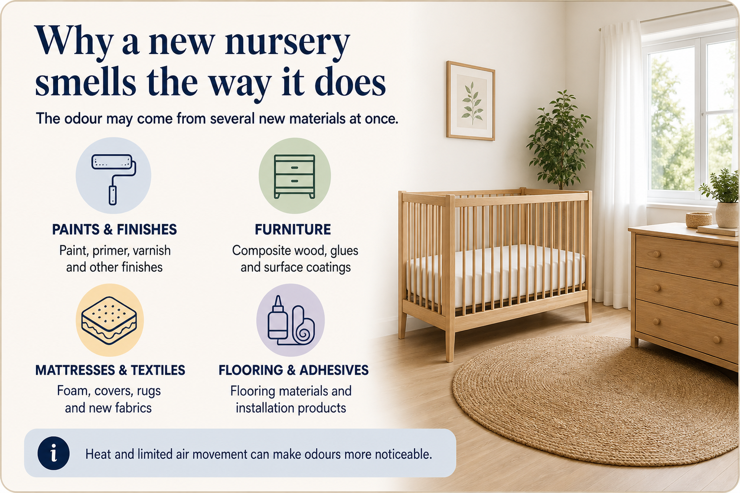
Paint tends to get the blame because it is easy to recognize. In a newly finished nursery, however, the odour may come from several products at once.
Possible sources include:
paint, primer, varnish and other finishes
flooring and installation adhesives
composite-wood furniture and cabinetry
mattresses, foam and waterproof covers
curtains, rugs and other new textiles
cleaning products and disinfectants
air fresheners, scented sprays and plug-ins
plastic wrapping and renovation materials left in the room
Health Canada describes VOCs as a large group of chemicals found in both indoor and outdoor air.[1] They are not a single pollutant with one source or one set of effects. Paint may release one mixture, while a new dresser, mattress or flooring adhesive releases another.

Formaldehyde is among the better-known indoor VOCs. Certain pressed-wood products, finishes and adhesives can release it, but it is only one possible part of the room's chemical mixture.[2]
Temperature and air movement also affect what you notice. A smell may become stronger when the nursery is warm, the door has been closed or the ventilation system is off.
Instead of asking only, “What is that smell?” ask three more useful questions:
What was recently brought into the room?
Where and when is the odour strongest?
Does it decrease with time and ventilation?
Those observations will not identify every compound, but they can help narrow down the likely source. This whole-room view is also how Puritas approaches an indoor air-quality assessment: by examining recent changes, materials, ventilation, air movement and the conditions under which an odour becomes more or less noticeable.
The smell may come from several new materials, not one obvious product.
Are VOCs in a nursery harmful?
There is no single answer because VOCs differ widely. The potential health effect of an exposure depends on the specific compound, its concentration, and how long and how often a person is exposed. At sufficient levels, some VOCs can irritate the eyes, nose or throat or contribute to headaches, dizziness and breathing discomfort.[1][3]
Health Canada identifies children and pregnant people among those who may be more susceptible to exposure. At the same time, it states that the levels of most VOCs normally found in Canadian homes do not usually pose a significant health risk.[1] Both facts deserve to remain in view. A noticeable smell is not evidence that a baby will become ill, but familiar products are not automatically free of emissions simply because they were bought for a nursery.
A baby's sleeping environment deserves particular attention because infants spend long periods close to the mattress, bedding, furniture and floor. Laboratory research has found that crib mattresses can emit VOCs and that concentrations close to a mattress can differ from those measured elsewhere in a room.[6] This does not mean a new mattress is unsafe, but the immediate sleep area should not be overlooked when an odour is persistent or localized.
The goal is not to predict a health outcome from a smell. It is to reduce avoidable exposure while the room is being prepared.
Odour alone cannot identify the chemicals present, their concentrations or their health significance.
What to do about a new nursery smell
You do not need to identify every chemical before taking sensible action. For most newly prepared rooms, the first steps are straightforward.
Finish painting and installation early
Complete painting, flooring work and furniture assembly as far in advance as practical. There is no universal number of days that makes every room ready because products emit at different rates, while temperature, humidity, ventilation and the amount applied all affect the timeline. Follow the manufacturer's instructions and look for a consistent decline in the odour.
Choose lower-emission products when possible
Product selection can reduce potential emissions before they enter the nursery. A low-VOC or zero-VOC paint may be a better choice than a conventional solvent-based coating, and water-based paints generally contain fewer VOCs than solvent-based alternatives.[7]
However, “zero VOC” refers to VOC content under a particular regulatory definition. It does not necessarily account for every volatile chemical that may matter indoors, and colourants or other additives can change the finished mixture.[7][8] Always follow the application and ventilation instructions.
For furniture made with composite wood, look for clear information about formaldehyde emissions rather than broad claims such as “natural” or “non-toxic.” In Canada, applicable products must comply with the Formaldehyde Emissions from Composite Wood Products Regulations. Some qualifying products may also be identified as NAF, meaning no added formaldehyde, or ULEF, meaning ultra-low-emitting formaldehyde.[9]
NAF does not mean that no formaldehyde can ever be measured, since formaldehyde occurs naturally in wood and may come from other materials. The useful objective is lower verified emissions supported by a recognized standard. Low-emission materials are a sensible preventive choice, not a substitute for ventilation or proper curing.
Remove leftover materials and packaging
Once the work is done, remove empty paint cans, adhesives, cleaning supplies, cardboard, plastic wrapping and other project materials. Do not store partially used products in the nursery closet.
Where practical, unpack furniture and mattresses in a clean, dry and well-ventilated space. A garage is not always suitable because exhaust, fuel, pesticides, dust and moisture can introduce other concerns.
Removing a source is generally more effective than trying to clean the air around it.[4]
Ventilate the room effectively
Open windows when weather and outdoor air quality allow. If the home has mechanical ventilation, use it as designed. Make sure supply vents, return grilles and transfer-air pathways are not blocked by furniture, curtains or stored items. Source control and ventilation are the two principal strategies recommended by the U.S. Environmental Protection Agency for reducing indoor pollutants.[4]
The nursery door can matter, too. In some homes, closing it reduces air movement because the room has no clear return-air path. Leaving it open may improve circulation, although circulation is not the same as introducing outdoor air. What matters is whether air can enter, move through and leave the room effectively.
Do not hide the odour with fragrance
A scented spray, candle or plug-in may overpower the new furniture or paint smell, but it does not remove the source. Fragranced products can add VOCs of their own and make it harder to judge whether the original condition is improving.[1] A clean nursery does not need to smell perfumed.
Track the pattern, not just the intensity
An odour becomes more informative when you observe how it behaves. Check whether it is strongest:
after the door has been closed for several hours
on warm or humid days
near the mattress, dresser, floor or a particular wall
after cleaning
when the ventilation system is off
after a newly unpacked item enters the room
Then notice what changes it. Does the smell weaken with ventilation, fade from day to day or return only when one item is in the room? This history can be valuable if a professional investigation becomes necessary.
Start with what changed: remove unnecessary sources, ventilate and observe whether the odour fades.
Will an air purifier remove nursery VOCs?
It depends on what the purifier is designed to remove.
A HEPA filter captures airborne particles. It may help with renovation dust, pollen and other particulate matter, but VOCs are gases, and a HEPA filter alone is not designed to remove them. Some air cleaners include activated carbon or another sorbent for certain gases, although their performance varies with the type and amount of filter media, the chemical involved, airflow and maintenance.[5]
There is no widely used consumer rating system for gas removal comparable to the clean air delivery rate used for particles.[5] The U.S. Environmental Protection Agency recommends source control and ventilation as the most effective starting points, with filtration used as a supplement.[4][5] An air purifier can be useful in the right situation, but it should not distract from the central questions: What is releasing the odour, can it be removed, and is enough clean outdoor air reaching the room?
Avoid devices that intentionally produce ozone. Ozone is a lung irritant and should not be introduced into an occupied nursery.[5]
HEPA filters capture particles. VOCs are gases and require a different approach.
When a closer indoor air-quality assessment may help
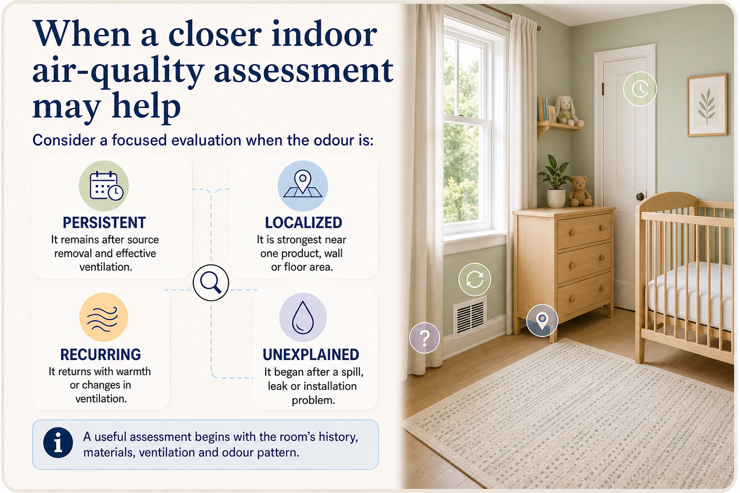
A smell that steadily fades after the room is aired out tells a different story from one that remains strong, repeatedly returns or seems concentrated near a particular product or part of the building.
Consider a closer evaluation when the odour:
persists despite source removal and effective ventilation
is concentrated near a particular piece of furniture, floor area or wall
returns when the room warms up or the ventilation changes
began after a spill, leak or installation problem
seems damp, musty or connected to a hidden building condition
is difficult to trace because several products were introduced at once
is accompanied by symptoms or a medical concern
An indoor air-quality investigation should start with the history of the room, not a random panel of tests. Testing is most useful when chosen to answer a specific question. A total VOC reading combines many compounds into one number, so it cannot identify every chemical present or determine health risk on its own.[3] Consumer sensors also vary in what they detect.
If a baby or another occupant has symptoms, seek advice from a qualified healthcare professional. An environmental assessment can examine the room and identify possible contributors, but it cannot diagnose the cause of a medical condition.
Persistent, localized or unexplained odours deserve closer attention when basic measures do not resolve them.
Let the room tell you what changed
A new nursery smell is worth noticing, but not fearing on smell alone. Look at the whole room, remove leftover materials, avoid adding fragrance and give new products time and effective ventilation. If the smell remains persistent, localized or unexplained, a focused investigation can help identify likely sources and determine whether testing would add useful information.
Puritas provides independent indoor air-quality assessments focused on possible sources, materials, ventilation, air movement and odour patterns. We do not sell air-cleaning equipment, perform cleaning, deodorization or réhabilitation work, or diagnose medical conditions. This separation allows our recommendations to remain focused on the evidence in the room.
If the nursery odour remains strong, repeatedly returns or seems concentrated near a particular material, [contact Puritas](/contact) to discuss whether an independent indoor air-quality assessment would be useful.
The useful question is not only what you smell, but what changed and whether conditions improve.
Frequently asked questions
How long should you air out a new nursery?
There is no universal waiting period. The appropriate time depends on the products used, the amount applied, temperature, humidity and ventilation. Complete major work early, follow manufacturer instructions and confirm that the odour is steadily decreasing before the room is used for long periods.[1][4]
Is it safe for a baby to sleep in a freshly painted room?
Follow the paint manufacturer's directions for ventilation, drying, curing and re-entry. Whenever possible, finish painting well before the room is needed. If the smell remains strong or anyone experiences symptoms, keep the room unoccupied and seek product-specific or professional advice.
Does low-VOC paint eliminate the need for ventilation?
No. Low-VOC and zero-VOC labels do not replace the product instructions or the need for ventilation during and after painting. The label describes VOC content under a particular definition and does not guarantee that the finished product will release no chemicals into indoor air. Paint may also be only one of several sources in a newly prepared nursery.[1][4][7][8]
Should you choose formaldehyde-free nursery furniture?
Choosing furniture with lower verified formaldehyde emissions is sensible, especially when several new products will be placed in one room. Look for products that comply with Canadian formaldehyde-emission requirements and, where available, recognized NAF or ULEF designations. Be cautious with absolute “formaldehyde-free” claims: formaldehyde occurs naturally in wood, and glues, finishes or other components may still emit chemicals.[2][9]
Is an air purifier enough for a new nursery smell?
Usually not. HEPA filtration addresses particles, while VOCs are gases. Activated carbon or other gas-removal media may reduce some VOCs, but performance varies. Begin with source removal and ventilation, then use filtration as a supplement where appropriate.[4][5]
If the smell is gone, have VOC emissions stopped?
Not necessarily. Some VOCs may be present below the level at which people can smell them, and others have little or no noticeable odour.[1] A fading smell is a useful sign that conditions are changing, but it is not proof that all emissions have stopped.
Does a strong smell mean the nursery is unsafe?
Not on its own. Odour intensity does not reveal which chemicals are present, their concentrations or their health significance. A strong, persistent, unusual or localized smell does deserve closer attention, particularly when it does not improve after likely sources are removed and the room is ventilated.
References
[1] Health Canada. “Volatile Organic Compounds"
(https://www.canada.ca/en/health-canada/services/air-quality/indoor-air-contaminants/volatile-organic-compounds.html ). Government of Canada, 2023.
[2] Health Canada. “Formaldehyde in Your Home"
(https://www.canada.ca/en/health-canada/services/environmental-workplace-health/reports-publications/air-quality/formaldehyde-indoor-air-environment-workplace-health.html). Government of Canada, 2021.
[3] Health Canada. “Guidance for Indoor Air Quality Professionals
(https://www.canada.ca/en/health-canada/services/publications/healthy-living/guidance-indoor-air-quality-professionals.html ). Government of Canada, 2025.
[4] U.S. Environmental Protection Agency. “Improving Indoor Air Quality
[5] U.S. Environmental Protection Agency. “Guide to Air Cleaners in the Home
[6] Boor, Brandon E., Helena Järnström, Atila Novoselac and Ying Xu. “Infant Exposure to Emissions of Volatile Organic Compounds from Crib Mattresses
(https://pubs.acs.org/doi/10.1021/es405625q ). *Environmental Science & Technology*, vol. 48, no. 6, 2014, pp. 3541-3549. DOI: 10.1021/es405625q.
[7] U.S. Environmental Protection Agency. “Controlling Pollutants and Sources: Indoor Air Quality Design Tools for Schools"
[8] U.S. Environmental Protection Agency. “Does EPA Regulate Volatile Organic Compounds in Household Products?" (https://www.epa.gov/indoor-air-quality-iaq/does-epa-regulate-volatile-organic-compounds-vocs-household-products). Updated 2026.
[9] Health Canada. “Guidance Document on the Formaldehyde Emissions from Composite Wood Products Regulations"

Comments